Thermal imager range is not a single fixed distance. A camera can detect a heat source when it occupies at least one detector pixel, while reliable temperature assessment or object recognition needs the target to cover more pixels.
To estimate a usable viewing distance, first define the task, then compare target size and required pixel coverage with the camera’s D:S ratio. A higher D:S ratio supports more target detail at the same distance.
Summary: Detection can begin at 1 pixel. Temperature assessment requires at least 3 × 3 pixels, object-type recognition requires at least 8 × 8 pixels, and distinguishing individuals requires at least 12 × 12 pixels. D:S ratio connects pixel coverage to distance.
What does “how far can a thermal imager see?” actually mean?
The answer depends on whether “see” means detecting heat, assessing temperature, recognizing an object type, or distinguishing one individual from another. These tasks require different amounts of detail on the detector or screen.
A distant heat source may be visible without providing enough pixel information for the user to identify what it is. For this reason, a quoted maximum distance should always be interpreted against the intended task and target size.
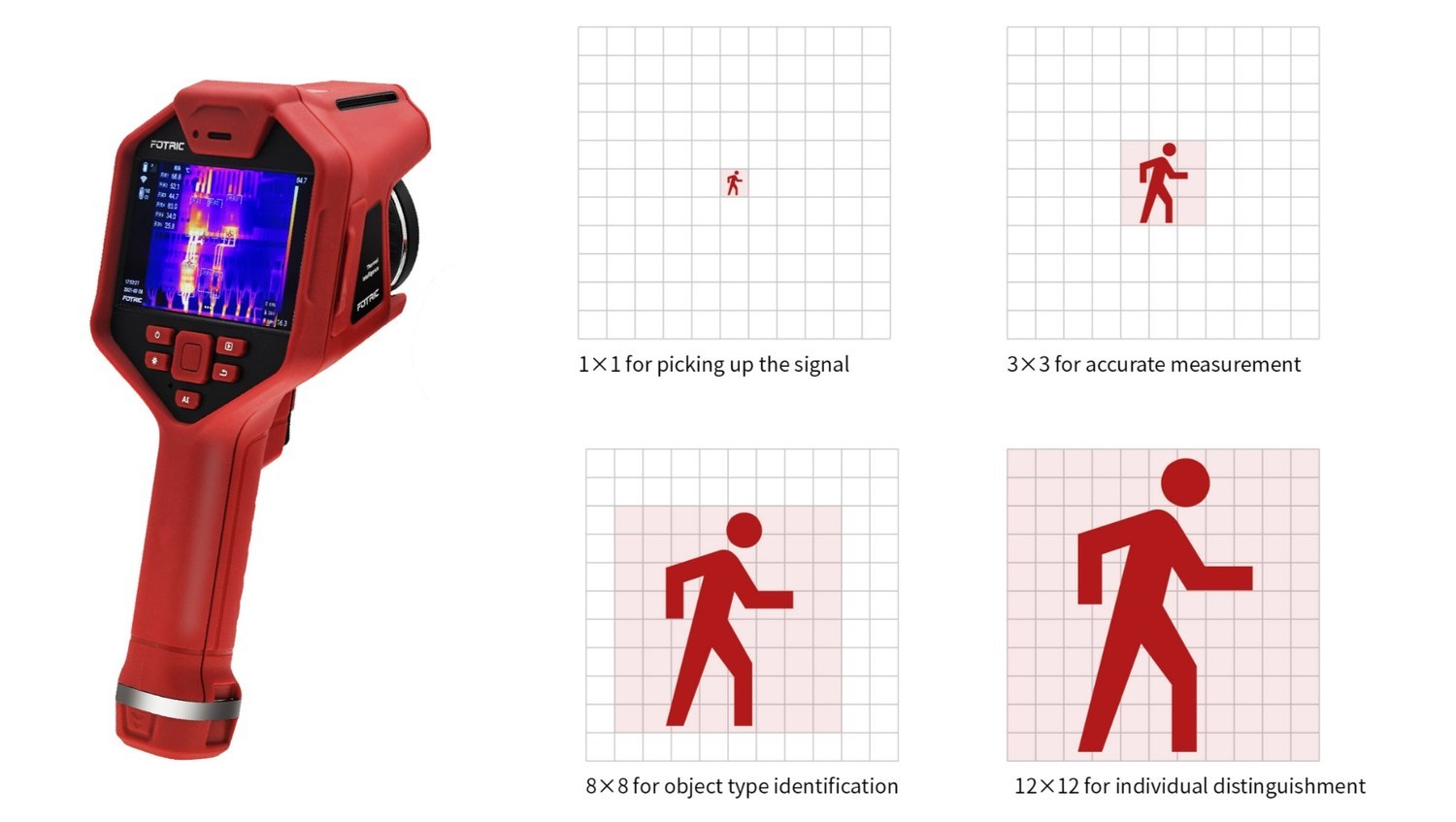
How many pixels does a target need in a thermal image?
A heat source needs to occupy at least one pixel to be detected. More demanding tasks need a larger pixel region because the IR thermometer must contain enough detail for temperature assessment or visual interpretation.
| Required task | Minimum target coverage on detector or screen |
|---|---|
| Detect a heat source | 1 pixel |
| Accurately assess temperature | 3 × 3 pixels |
| Recognize the type of object | 8 × 8 pixels |
| Distinguish one individual from another | 12 × 12 pixels |
For example, a target that fills an 8 × 8 pixel region can provide enough information for a person to recognize a broad object type, such as a tree, animal, or car. It does not necessarily provide enough detail to distinguish one individual from another.
What is the D:S ratio on a thermal imager?
D:S ratio means Distance to Surface Diameter ratio. It describes the relationship between the distance from observer to object and the diameter covered by one pixel at that distance.
In practical terms, a larger D:S ratio means one pixel covers a smaller area at a given distance. This allows the thermal imager to obtain more detail from the target while meeting the pixel threshold required for detection, assessment, or recognition.
How does D:S ratio affect thermal imaging distance?
D:S ratio affects whether a target remains large enough in pixels at a selected distance. Once the target becomes too small on the detector, the camera may still detect heat but may no longer support the required level of temperature assessment or identification.
The source calculation describes the relationship as follows: determine the required pixel coverage, divide the target’s physical dimension by the relevant pixel count to find the dimension covered by one pixel, then multiply that pixel dimension by the camera’s D:S ratio to estimate the maximum distance for that task.
Note: The same thermal imager can have different usable distances for the same target because detection, temperature assessment, and recognition use different pixel thresholds.
What D:S ratio is needed to recognize a 0.2 m target at 20 m?
Using the provided hare example, recognizing the type of animal at 20 m requires an 8 × 8 pixel target region. If the animal’s cross-section is assumed to be 0.2 m by 0.2 m, each pixel must cover 0.2 ÷ 8 = 0.025 m in one dimension.
The required D:S ratio is then 20 ÷ 0.025 = 800:1. Under these assumptions, a thermal imager needs at least an 800:1 D:S ratio for the 0.2 m target to meet the stated recognition threshold at 20 m.
| Calculation item | Value in the example |
|---|---|
| Target cross-section | 0.2 m × 0.2 m |
| Recognition requirement | 8 × 8 pixels |
| One-pixel dimension | 0.025 m |
| Observation distance | 20 m |
| Required D:S ratio | 800:1 |
How should you choose a thermal imager for a distance-sensitive task?
Start with the physical size of the target, the viewing distance, and the result required from the image. A task that only needs heat detection can work with less target pixel coverage than a task requiring temperature assessment or recognition.
Then verify that the camera’s D:S ratio can keep the target above the relevant pixel threshold at that distance. This approach avoids treating thermal ca range as a universal specification and instead matches the thermal camera capability to the required observation detail.