After a fire or ahead of renovation, floor-addition, or change-of-use projects, inspecting surface cracks alone or taking random core samples is not enough to determine the remaining load-bearing capacity of a structure. Under the post-fire conservation and structural assessment principles of TCVN 14104:2025, inspection teams must accurately quantify heat-damaged concrete cross-section loss, subsurface delamination zones, and internal rebar condition before planning strengthening works.
Combining ground-penetrating radar (GPR), electromagnetic rebar scanners, and ultrasonic concrete testers forms a comprehensive non-destructive testing (NDT) workflow that maps internal defects without further weakening thermally stressed members.
Key Focus for Post-Fire & Renovation Assessment Under TCVN 14104:2025:
Identify boundaries where concrete loses chemically bound water above critical temperatures, check bond degradation between concrete and reinforcement, and reconstruct multi-layer rebar layouts at planned anchor drilling or opening cut locations.
1. Thermomechanical Changes in Reinforced Concrete Under TCVN 14104:2025
National standard TCVN 14104:2025 (Concrete and reinforced concrete structures – Principles for ensuring fire resistance and post-fire preservation) defines clear concepts for the critical heating temperature of concrete and the critical heating temperature of reinforcement. During prolonged fires, heat conduction from the surface into the member core creates layered damage: outer concrete exposed above 500°C loses chemically bound water in the cement paste, changes color, experiences sharp modulus drops, and detaches from rebar.
A major hazard in field evaluation is that many delamination zones or internal micro-cracks lie deep beneath a surface that appears intact. Relying solely on a surface rebound hammer will misrepresent actual core strength. Similarly, in renovation projects lacking as-built drawings, drilling chemical anchors or cutting slabs without prior scanning risks severing primary load-bearing rebar or prestressing tendons.
2. Combining GPR and Rebar Scanners in Field Investigations
To overcome the limits of any single method, modern inspection workflows pair two non-destructive scanning technologies with complementary physics. Ground-penetrating radar (GPR) transmits high-frequency electromagnetic pulses into concrete and records reflections at interfaces with differing dielectric constants. With deeper penetration, GPR detects second- and third-layer rebar grids, prestressing tendons, non-metallic conduits, and voids or thermal delamination seams after a fire.
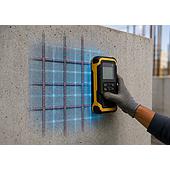
Meanwhile, eddy-current / electromagnetic rebar scanners focus on the shallow zone from the surface down to roughly 180 mm. Their core advantage is measuring concrete cover depth to millimeter precision and estimating bar diameter—two essential inputs for recalculating actual fire resistance limits and residual load-bearing capacity of beams and columns under TCVN 14104:2025.
| NDT Inspection Tool | Principle & Effective Depth | Output Data for TCVN 14104:2025 & Renovation |
|---|---|---|
| Ground-Penetrating Radar (GPR) | High-frequency EM waves; 300–800 mm scan depth depending on antenna. | Maps multi-layer rebar, prestressing tendons, delamination boundaries, and subsurface voids. |
| Electromagnetic Rebar Scanner | Electromagnetic induction / eddy current; accurate measurement from 10–180 mm. | Measures concrete cover depth (mm) accurately and estimates rebar diameter (d). |
| Ultrasonic Pulse Velocity Tester | Measures ultrasonic pulse transit velocity through concrete. | Evaluates elastic modulus loss, thermal crack depth, and internal concrete uniformity. |
3. Field Execution Workflow and Inspection Data Processing
At a post-fire site, the first step is zoning thermal exposure based on surface discoloration, spalling, and comparative ultrasonic pulse velocity readings between fire-affected zones and undamaged structural areas. Where degradation is suspected, engineers mark a coordinate grid directly onto beam, column, or slab surfaces at 100 mm to 200 mm spacing.
Next, the GPR antenna is scanned along two orthogonal grid axes to generate B-scan cross-sections and 3D spatial maps, pinpointing concrete-to-rebar delamination or dense reinforcement zones. At clear points free of overlapping bar layers, engineers use an electromagnetic rebar scanner to measure remaining concrete cover (accounting for spalled thickness) and verify bar diameter. These results feed directly into post-fire load-capacity checks to decide between chipping damaged concrete, applying high-strength repair mortar, or installing fiber-reinforced polymer (FRP) jackets.
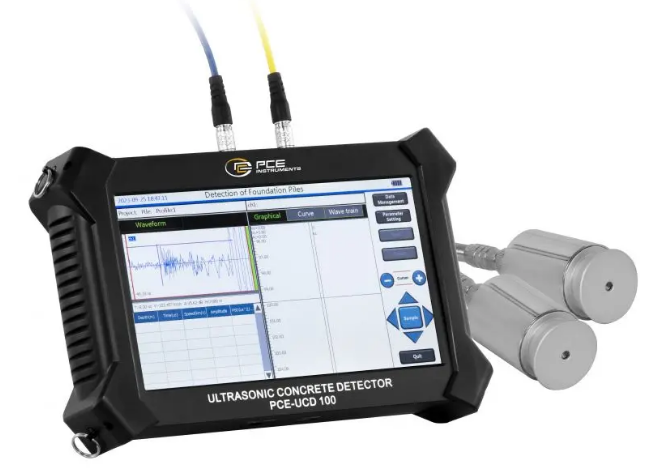
4. Representative Concrete Inspection Equipment Configurations on EMIN
To ensure reliable data for renovation verification and post-fire structural assessments, LAS-XD laboratories and inspection consultancies should deploy coordinated instruments capable of visual data export.
Swiss-Engineered GPR Systems and Rebar Scanners
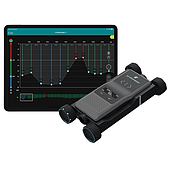
For detailed surveys of multi-layer reinforcement, deep transfer beams, or post-tensioned slabs, PROCEQ GP8000 ground-penetrating radar using stepped-frequency continuous-wave (SFCW) radar displays crisp 2D/3D cross-sectional views on an iPad, distinguishing upper and lower rebar layers as well as subsurface voids. Paired with PROCEQ PM8000 Pro rebar diameter and cover meter (or standard Proceq Profoscope rebar locator), engineers can map concrete cover for corrosion and fire resistance evaluations.
Rapid Rebar Locating and Ultrasonic Concrete Quality Testing
For routine site checks or pre-drilling surveys during structural retrofits, ZBL-R630 rebar scanner covers 10 mm to 180 mm cover depth with convenient grid data logging.
Explore ultrasonic concrete testers, rebar locators, and GPR systems at EMIN Vietnam.