What is harmonics?
Harmonics are unwanted disturbances in the power system that can degrade the quality of the grid and cause problems if they exceed acceptable limits.
Harmonic currents have frequencies that are multiples of the fundamental frequency. For example, with a 50Hz grid, a 250Hz current corresponds to a 5th harmonic. This current cannot be used for electrical equipment but instead is converted into heat energy, causing waste and affecting operating efficiency.
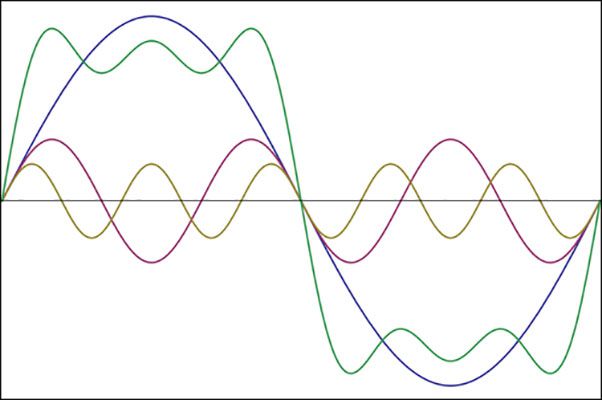
Harmonics are characterized by oscillations across the entire industrial frequency spectrum. In AC power systems, they are defined as sine wave components with frequencies that are integer multiples of the fundamental frequency:
fh = h.fb, where h is a positive integer.
Main causes of harmonics
Harmonics are mainly caused by nonlinear loads in the power system. Although the input voltage of these loads is sinusoidal, the current passing through them is distorted, no longer retaining the original sinusoidal waveform.
Any waveform can be analyzed as a combination of fundamental sinusoids and their multiples. When a waveform repeats itself from one cycle to the next, it can be represented by a Fourier series – consisting of the fundamental sinusoid and higher harmonics.
During the calculation, each harmonic component can be analyzed individually and then combined to form the overall waveform if necessary. However, in practice, the amplitude of the harmonics is the most important factor to consider. If a waveform has a symmetrical structure between the positive and negative half cycles, the Fourier series contains only odd harmonics. Therefore, most electrical devices usually only generate and are affected by odd harmonics such as 3, 5, 7, etc.
Devices that cause harmonics
Harmonics can arise from a wide range of electrical equipment in both industrial and residential applications.
In industry, equipment such as arc furnaces, welding machines, electronic starters, power electronics, or switching operations of large transformers are all significant sources of harmonics.
In residential applications, equipment such as discharge lamps, televisions, computers, photocopiers, and microwave ovens can also contribute to harmonic interference in the power grid..
Harmful effects of harmonics
Harmonics are a form of interference that directly affects power quality, especially when the system uses nonlinear loads. If not controlled, it can cause many negative impacts on equipment and machinery in the factory, including:
Reducing motor life due to unstable current.
Causing overload, overheating in CBs and transformers, which can even lead to explosions.
Causing circuit breakers, circuit breakers, and fuses to be affected without a clear cause.
Reducing the life of compensation capacitors, in some cases, causing capacitor explosions.
Causing interference, affecting telecommunications equipment and automation systems.
Distorting the results of measuring devices.
Increasing unnecessary energy consumption, causing waste in operation.
Harmonic reduction method
Replacing damaged equipment due to harmonics is an expensive solution, increasing investment and operating costs but still cannot completely solve the problem. Therefore, it is necessary to choose more effective and economical harmonic control methods such as:
- Using AC or DC reactors for inverters - Suitable solution when the grid is heavily disturbed but the requirement of harmonic reduction is not the top priority.
- 12-pulse rectifier - Provides high efficiency in harmonic reduction but comes with a complex implementation process.
- Use low harmonic inverters – Inverters that integrate harmonic reduction technology without the need for external filters or multi-pulse transformers, with a total harmonic distortion (THDi) of less than 5%.
- Use harmonic filters – Suitable for systems with multiple inverters operating in parallel on the same line, helping to compensate for power, reduce voltage and current harmonics.
- Harmonic filters are divided into two main types:
- Zero-sequence harmonic filters (ZSF) – Use zigzag wound transformers to reduce or eliminate zero-sequence harmonics, with a filtering efficiency of 60% – 95%.
- Active Harmonic Filter – Works by generating opposite harmonics, effectively reducing noise with a filtering efficiency of 80% – 95%.
Read more at: Reducing the risk of harmonics on the grid