Rotary Switches
When equipment needs a clear, repeatable way to select circuits, modes, or operating positions, a mechanical selector is often still the most practical choice. Rotary switches remain widely used in industrial controls, electronic assemblies, instrumentation panels, and compact interface designs because they provide tactile position selection with straightforward electrical switching logic.
In this category, buyers can compare rotary switch options for different mounting styles, position counts, actuator formats, and application needs. Whether the requirement is a panel-mounted selector for control hardware or a compact PCB part for embedded electronics, the right choice depends on how the switch will be used, how many positions are required, and the electrical load involved.
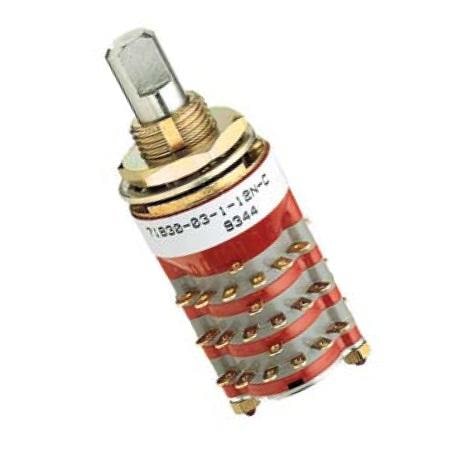
Where rotary switches are typically used
A rotary switch is designed to change connections by turning an actuator through fixed positions. This makes it useful wherever operators or service technicians need a simple way to select channels, operating modes, ranges, or configuration settings without relying on software-based input alone.
Common use cases include control panels, test and measurement devices, communication equipment, power distribution interfaces, and compact electronic modules. In some designs, rotary switches are chosen for front-panel user interaction; in others, they are used as board-level configuration elements similar to coded selectors or setup switches.
Key selection points before you buy
The most important starting point is the number of positions and how the switching sequence should behave. Some applications need only a few defined states, while others require multi-position selection for range setting, signal routing, or function control. Pole and circuit arrangement also matter, especially when one rotary action must control more than one electrical path.
Mechanical form is equally important. Buyers should review mounting method, shaft or actuator style, available panel space, and expected operating life. Environmental conditions such as operating temperature, vibration, and handling frequency can also influence the right choice, particularly in industrial settings where durability and repeatable switching are critical.
Electrical requirements should never be treated as secondary. Current and voltage ratings must align with the actual load, and low-level signal switching may call for a different product style than direct power selection. For applications involving isolation or power interruption, related categories such as disconnect switches may be more appropriate than a standard rotary selector.
Typical product formats in this category
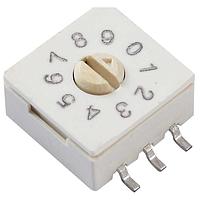
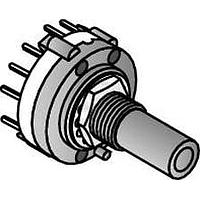
This category includes both compact electronic rotary switches and more robust selector-style units. PCB-oriented models are often used where space is limited and settings need to be defined directly on the board. These may feature screwdriver actuation, through-hole installation, or small-footprint construction for embedded assemblies.
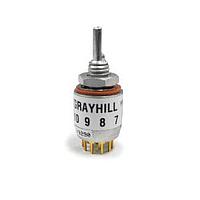
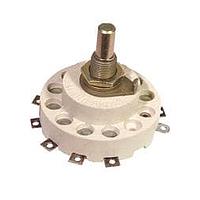
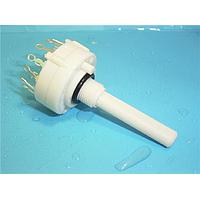
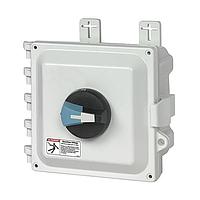
Panel-oriented designs are more common in operator-facing equipment, where a knob or shaft allows manual selection. Depending on the product, buyers may find options intended for low-current signal paths, coded switching, or more rugged machine and control-system operation. If the project also involves operator protection or machine interlocks, it can be helpful to review safety switches for adjacent system requirements.
Examples from leading manufacturers
Several well-known suppliers are represented in this range. Alps Alpine appears in both compact rotary switch and related selector-style components, making it relevant for electronics and interface design. Parts such as the SRRM1C7800 and SRBD170101 illustrate how multi-position switching can be integrated into smaller assemblies where precise indexing matters.
For applications that need established industrial switching hardware, Eaton is also a notable option. The Eaton T0-2-1/E is an example of a rotary switch format often associated with control and power-related environments. On the compact component side, Bourns offers solutions such as the 7829H-1-023LF, which suits designs looking for board-level rotary selection in a smaller package.
Other examples in the category include the ITT Cannon MG00L1NZQD and multiple KYOCERA AVX rotary switch variants, which help broaden the available range for engineers comparing footprint, switching arrangement, and interface style. Rather than focusing only on brand preference, it is usually more effective to shortlist parts by switching function, mounting method, and electrical duty first.
How to match a rotary switch to the application
For control panels, start with visibility, ease of operation, and panel integration. A shaft-operated or front-access design may be preferable when users need quick manual selection. In these installations, spacing around the operator interface, labeling, and resistance to accidental mis-selection can be just as important as the electrical specification.
For PCB and embedded designs, focus more on footprint, soldering method, actuator access, and configuration stability. Screwdriver-actuated or compact through-hole parts can work well where settings are adjusted occasionally rather than continuously. If the switch is part of a wider electronic control architecture, buyers may also compare alternatives such as solid state switch devices where non-mechanical switching is required elsewhere in the design.
For serviceable or configurable equipment, consider how clearly the positions are indexed and whether maintenance staff need to change settings in the field. A switch that is electrically suitable but difficult to access or interpret can create avoidable downtime during setup or repair.
What to review on individual product pages
Once a shortlist is created, product-level details become decisive. Check the rated current and voltage, position count, pole configuration, mounting style, operating temperature, and actuator type. These factors directly affect fit, reliability, and user experience in the finished assembly.
It is also worth reviewing whether the part is intended for frequent manual operation or occasional configuration changes. For example, some devices are optimized for compact signal selection, while others are better suited for more visible manual control. Accessory needs may also matter during installation, especially in panel builds or switch assemblies that require supporting hardware from categories such as other switch accessories.
Choosing with more confidence
The best rotary switch is not simply the one with the highest position count or the most familiar brand name. A suitable part is one that matches the electrical path, installation method, user interaction, and environmental demands of the equipment it will serve.
By comparing switching format, mechanical design, and application context, buyers can narrow down the range more efficiently and avoid mismatches later in the project. This category is built to support that evaluation process, from compact board-level selectors to more application-focused rotary switching solutions for industrial and electronic systems.
Get exclusive volume discounts, bulk pricing updates, and new product alerts delivered directly to your inbox.
By subscribing, you agree to our Terms of Service and Privacy Policy.
Direct access to our certified experts