1. What Is the Difference Between Dew Point and Dew Point Temperature?
Dew point is a crucial concept in meteorology, industry, and daily life. It refers to the condition when air becomes saturated with water vapor, leading to condensation. Dew point temperature is the specific temperature at which this saturation occurs, causing water vapor to condense into droplets.
For example, in the coating industry, if the dew point temperature is not properly controlled, moisture can condense on material surfaces, resulting in paint peeling and reduced project quality.
2. Common Methods for Measuring Dew Point Temperature
2.1. Calculating Dew Point Temperature Using Formulas
One traditional method for determining dew point temperature is through mathematical formulas, with the Magnus-Tetens formula being the most widely used. This formula calculates the dew point temperature based on air temperature and relative humidity.
Magnus-Tetens Formula:
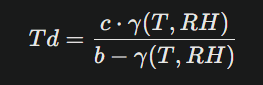
Where:
Td: Dew point temperature (°C)
T: Air temperature (°C)
RH: Relative humidity (%)
b=17.625, c=243.04
For instance, if the air temperature is 25°C and the relative humidity is 60%, applying this formula yields a dew point temperature of about 16°C. This helps engineers predict when condensation will occur in compressed air systems or clean rooms.
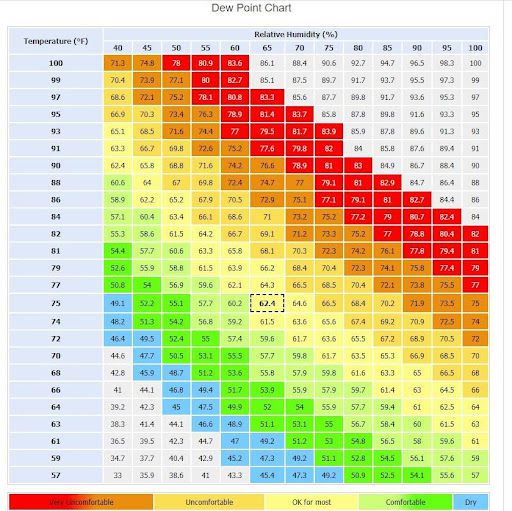
2.2. Using Dew Point Temperature Reference Tables
Dew point reference tables are practical tools that allow for quick determination of dew point temperature based on known values such as air temperature and relative humidity. This method is simple and easy to apply, especially when specialized measuring devices are unavailable.
In food manufacturing plants, technicians often use these tables to quickly check the dew point temperature, ensuring the production environment meets hygiene and food safety standards.
2.3. Using Dew Point Meters
A dew point meter is a modern device that directly measures dew point temperature with high accuracy. Current dew point meters typically use electronic sensors or the chilled mirror method to precisely detect when condensation begins.
Advantages of dew point meters:
High accuracy and intuitive digital display.
Ability to store and analyze data.
Widely used in industry, laboratories, compressed air systems, HVAC, and many other fields.
In the compressed air industry, dew point meters help control air quality, prevent water condensation in pipelines, protect equipment, and optimize operational efficiency.
See more: What are the ways to determine the dew point temperature of compressed air?
3. Practical Applications of Dew Point Temperature Measurement
3.1. Manufacturing Industry
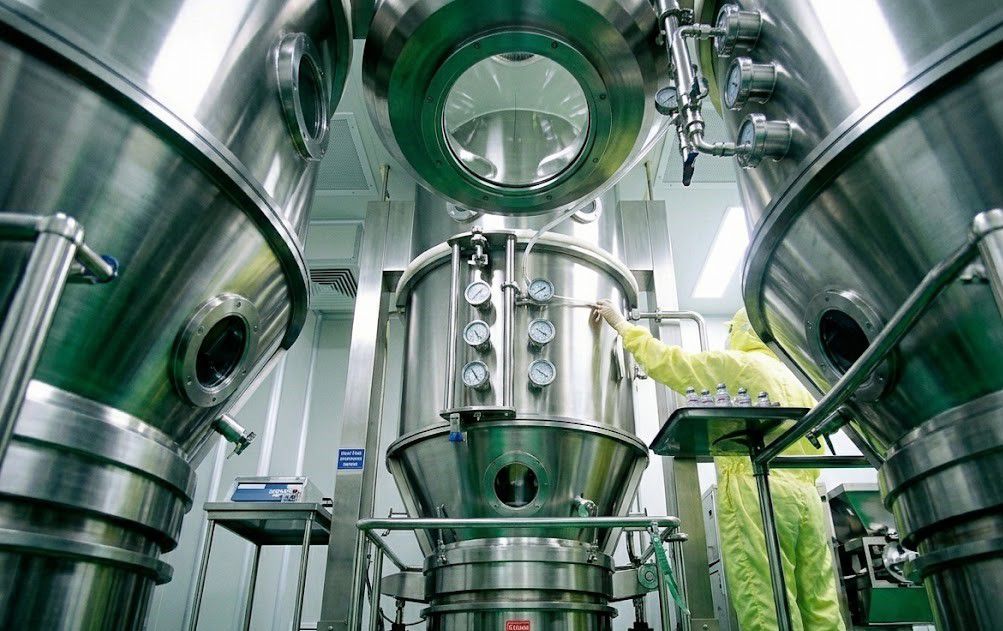
In manufacturing plants, controlling dew point temperature ensures product quality, especially in sectors like coatings, food, and pharmaceuticals. If the dew point temperature is not managed, moisture can damage equipment or reduce product quality. For example, an electronics factory uses a dew point meter to keep the production environment dry, preventing condensation that could cause short circuits.
In real-world industrial environments, humidity is not a constant. When ambient temperatures drop sharply at night or during the operation of cooling systems, the risk of condensation on material surfaces skyrockets. Without continuous in-line dew point measurements, risks such as potential chemical corrosion inside pipes or damage to delicate electronic circuit boards are difficult to detect early. Using data logging devices not only helps control quality in real time but also provides a crucial database for engineers to analyze and predict "risk zones" in the production process, thereby proactively adjusting HVAC systems or humidity control to ensure stable and sustainable operation.
3.2. Compressed Air and HVAC Systems
In compressed air systems, dew point temperature is a key indicator of air quality. If the dew point is too high, water will condense in the pipes, causing corrosion and reducing equipment lifespan. Similarly, in HVAC systems, controlling the dew point helps maintain a healthy environment, prevent mold, and protect human health.
3.3. Meteorological Research
Dew point temperature is essential in weather forecasting, climate research, and air quality assessment. Meteorological stations use dew point meters to collect data for predicting rain, fog, and extreme weather events.

4. Advertisement: ELCOMETER G319 Dew Point Meter – The Accurate Dew Point Temperature Solution
If you are looking for a professional dew point temperature measuring device, the ELCOMETER G319 Dew Point Meter is an ideal choice. This UK-made product stands out with the following features:
Measures multiple parameters: relative humidity, air temperature, surface temperature, dew point temperature, temperature difference, dry temperature, wet temperature, and specific humidity.
Wide measuring range: from -20°C to +80°C, with high accuracy of ±0.5ºC.
Data storage, clear display, and easy operation.
Compact and robust design, suitable for both industrial and laboratory environments.
Flexible power supply: AA batteries or USB cable, with long battery life.
Official warranty, quality assurance, and home delivery.
Các câu hỏi thường gặp về Nhiệt độ điểm sương
1. Why is dew point temperature measurement necessary in industry?
Controlling the dew point temperature is crucial to preventing condensation. In industry, condensation causes pipe corrosion, paint peeling, damage to electronic components, and reduced product quality in the food and pharmaceutical industries. Controlling the dew point helps protect equipment and optimize system performance.
2. How to quickly calculate the dew point temperature without a meter?
You can use the Magnus-Tetens formula if you know the air temperature and relative humidity. However, the quickest and most practical way is to use a dew point temperature lookup table. Simply align the ambient temperature and relative humidity on the table to determine the instantaneous dew point value.3. Sự khác biệt giữa máy đo điểm sương điện tử và phương pháp gương làm lạnh là gì?
Electronic sensor meters: Use semiconductor components to measure humidity and temperature, and calculate the dew point. Advantages include compactness, portability, and ease of use.
Chilled mirror meters: Cool the mirror surface until dew begins to form. This is considered a primary standard with extremely high accuracy, often used in laboratories to calibrate other equipment.