The growing demand for wire and cable processing in industries such as electronics, automotive manufacturing, electrical equipment, and control panel assembly has raised the standards for processing accuracy. Even a slight deviation in cutting length or insulation stripping length can affect terminal crimping, assembly efficiency, and final quality inspection.
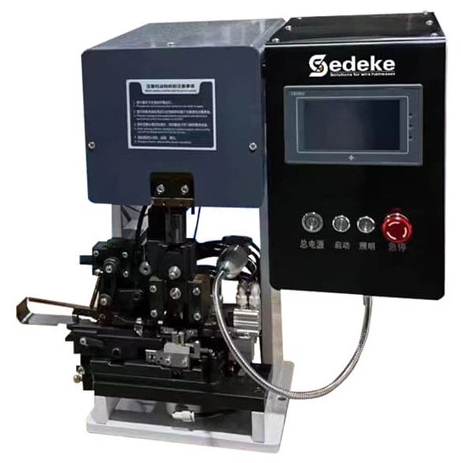
For this reason, many manufacturers are replacing conventional equipment with an automatic wire stripping machine. Equipped with a servo drive system, these machines provide precise position control, fast response, and consistent performance, even during long production runs.
Although the initial investment is higher, the benefits become apparent in production environments where precision, consistency, and efficiency are essential.
High-Volume Production
An automatic wire stripping machine maintains consistent cutting and stripping performance throughout continuous operation, minimizing dimensional variations after extended working hours. As a result, manufacturers can reduce rework, improve product consistency, and keep production schedules on track.
For companies handling large production orders or operating multiple shifts, the investment is often offset by higher productivity and lower operating costs.
Increasing Demands for Precision
Industries such as electronics, medical devices, aerospace, and automotive wiring require extremely accurate cutting and stripping dimensions.
Wire stripping machine offers superior motion control, helping reduce dimensional deviations between products within the same production batch. The result is uniform wire ends while minimizing problems such as conductor damage caused by over-stripping or incomplete insulation removal that complicates terminal crimping.
Product Profile Changeovers
Wire stripping machine typically support multiple programmable processing profiles. Operators can simply select a saved program instead of manually adjusting every parameter.
This significantly reduces setup time and minimizes configuration errors when switching between products with different wire lengths, stripping lengths, or cutting specifications. Whether processing copper wire, coaxial cable, high-voltage cable, or multi-core cable, production changes become faster and more efficient.
Rising Costs Caused by Defective Products
Every defective product results in more than wasted wire. It also increases inspection time, rework, labor costs, and production delays.
If quality issues frequently occur because of inconsistent cutting lengths or inaccurate insulation removal, upgrading to a servo-driven wire insulation stripping machine can significantly improve production stability while reducing scrap rates.
Supporting Automated Production Lines
Industrial automation continues to evolve from individual machines toward fully integrated production lines that combine wire cutting, insulation stripping, terminal crimping, wire marking, and quality inspection.
An automatic wire stripping machine is designed to integrate smoothly with other equipment, supporting programmable operation and synchronized workflows. This makes it an ideal solution for manufacturers expanding production capacity or building smart manufacturing facilities.
Choosing the Right Equipment for Your Production Needs
If production volume is relatively small, processing requirements are straightforward, and wire specifications rarely change, a standard Wire Cut and Strip Machine may provide sufficient performance at a lower investment cost.
Today, wire insulation stripping machines are available for a wide range of production capacities, from single-core and multi-core wire processing to fully automated cutting and stripping systems.
An automatic wire stripping machine delivers the greatest value when manufacturers require high productivity, consistent precision, flexible product changeovers, and low defect rates.
Before making an investment, companies should evaluate the wire sizes they process most frequently, daily production volume, required processing accuracy, and future expansion plans. Selecting the right wire stripping machine from the beginning helps maximize equipment utilization, reduce operating costs, and maintain high product quality throughout the machine's service life.
Recommended Some Automatic Servo Wire Stripping Machines from EMIN: Sedeke TM-20SCS, JCW-CS07, JCW-CS05B