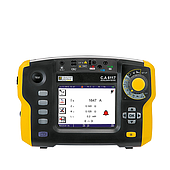
When checking a fiber optic link or reading values on an Optical Power Meter, technicians often confuse two parameters: dBm and dB.
What is dBm in optical power measurement ?
dBm is the unit used to express optical power at a specific measurement point.
When an optical power meter is connected to a fiber optic link, the device typically displays the received signal level in dBm. This value indicates the amount of optical energy present at the time of measurement, rather than the overall quality of the transmission link.
For example, if the receiver displays −8 dBm, it means the optical power reaching that point is −8 dBm. However, this value alone does not indicate how much loss has occurred along the link.
In daily measurement tasks, dBm is commonly used as the first parameter to verify the output of an optical transmitter, confirm that the receiver is receiving sufficient signal, monitor transmission status, or evaluate power levels before and after maintenance.
What does dB represent ?
If dBm indicates how much power exists at a given point, dB expresses the difference between two power levels.
In fiber optic testing, dB is commonly used to represent the amount of attenuation that occurs as the signal travels through the transmission path.
Example:
Transmitter output: 0 dBm
Receiver input: −2 dBm
Link loss result: 2 dB
In this case, 2 dB is not the power level present in the link—it represents the amount of signal lost during transmission.
This is why fiber attenuation testing is typically performed using an optical light source together with an optical power meter.

Why are dBm and dB often confused in optical measurements?
Many optical power meters allow users to switch quickly between power measurement mode and loss measurement mode. During continuous operation, users often focus on the numerical value and overlook the unit being displayed.
A typical test procedure may begin by recording transmitter output power, then measuring received power and calculating attenuation. Without verifying the measurement unit at each step, inconsistent or misleading data can easily appear in the final report.
When should you read values in dBm and when in dB?
The appropriate unit depends on the objective of the measurement.
If the goal is to determine whether the optical transmitter is operating normally or whether the receiver is receiving sufficient signal, dBm is the value to monitor.
If the objective is to evaluate link quality, determine attenuation, or compare performance before and after maintenance, dB is the more relevant measurement.
Understanding the difference between these two units makes interpreting measurement results more straightforward and supports more accurate assessment of fiber optic link performance and transmission system operation.
When the principles behind each unit are clearly understood, reading results from an Fiber Optic Power Meter becomes more reliable, helping technicians evaluate both fiber link condition and overall system performance.