Classification based on aerodynamics
First of all, PM10 is a group of particles smaller than 10 micrometers in size, “coarse” particles that can be inhaled but are often retained in the nose and throat. PM2.5 is a group of particles smaller than 2.5 micrometers, capable of penetrating deep into the lungs, known as fine dust. PM1.0 is the smallest part of this group, often more toxic due to its large contact surface and ability to stay in the body for a long time. At an even smaller level, UFP (Ultrafine Particles) are particles with a diameter of less than 0.1 micrometers, so small that they can penetrate biological tissue, enter the blood and even cross the blood-brain barrier.
In other words, the smaller the particle size, the greater the biological penetration and the higher the danger. PM10 is visible to the naked eye, PM2.5 often causes the air to hazy on polluted days, while UFP are completely invisible but are the hardest for the body to resist.
Origin of Formation: Mechanical and Chemical
The difference in size also means a difference in origin.
PM10 is mainly generated by mechanical and natural processes. When vehicles move, wind blows over the road surface, or construction works, large dust particles are detached from the surface and dispersed into the air. There are also fly ash from agriculture, soil dust, pollen or mold spores. These particles are called primary particles, because they are generated directly from the emission source without undergoing chemical transformation.
In contrast, PM2.5, PM1.0 and UFP are mainly formed from combustion processes and secondary chemical reactions in the atmosphere. Exhaust fumes from diesel engines, thermal power plants or metal smelters generate numerous fine particles. Then, precursor gases such as sulfur dioxide (SO₂) and nitrogen oxide (NOₓ) react with water vapor and ammonia to form sulfate and nitrate compounds, which are the main components of PM2.5. Meanwhile, UFP are the first products of combustion, formed when hot volatiles condense into extremely small particles. They can last a long time in the air and are the “seeds” that develop into PM1.0 or PM2.5 later.

Mechanism of Biodegradation and Bio-Infiltration
The damage caused by fine dust depends on where it lands in the respiratory system. According to the International Commission on Radiological Protection (ICRP), there are three main areas of deposition in the body.
In the nose and throat, large particles such as PM10 are trapped by inertial collisions. When the air flow changes direction suddenly, the heavy particles cannot turn in time and hit the walls of the nose or throat. This will cause irritation, rhinitis or aggravate asthma attacks.
Moving deeper into the trachea and bronchi, PM2.5 particles begin to settle due to gravity. Prolonged accumulation weakens the cilia, reducing the lungs' ability to clean themselves and leading to chronic bronchitis.
Of greatest concern is the alveolar region, where gas exchange takes place. Ultra-fine particles such as PM1.0 and UFP do not fall or collide, but move randomly in Brownian motion, easily passing through the thin alveolar membrane and entering the bloodstream. Because of the significant health risks, regular monitoring of air quality in living areas, offices and manufacturing areas is required.
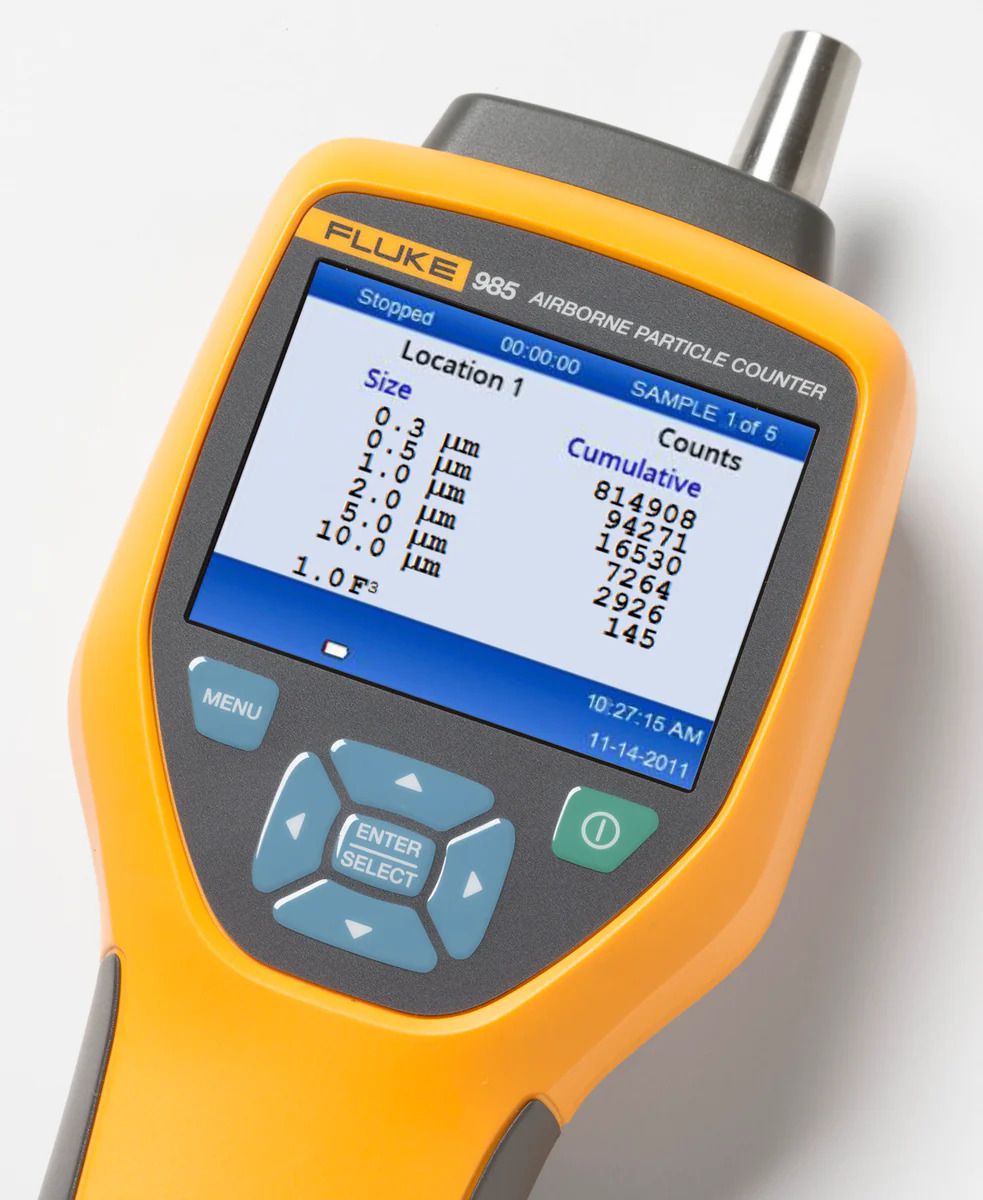
This is where EMIN's portable, handheld particle counters come in. With their compact size and high accuracy, devices like the FLUKE-985 or Lighthouse Handheld allow users to easily perform spot checks or instantly identify sources of PM2.5 and PM1.0 pollution at any point, providing important data to protect human health.
Microscopic Toxicity and Neuroinvasiveness of UFP
In modern environmental research, the focus has shifted from “dust mass” to “particle number density”. The reason is that UFP, despite their very small mass, have extremely large numbers and high surface activity.
With their outstanding surface area per volume, these ultrafine particles strongly adsorb heavy metals and toxic organic compounds. When they come into contact with cells, they release a series of oxidation reactions, creating oxidative stress and systemic inflammatory responses. This is the reason why UFP are considered the most biotoxic group of particles among all dust types.
Oberdörster's (2005) study also showed that UFP can penetrate the blood-brain barrier or travel along the olfactory nerve, directly entering the central nervous system. This phenomenon is closely linked to neurodegenerative diseases such as Alzheimer's and Parkinson's, posing a major challenge to environmental medicine in the 21st century.
The Core of Air Quality Management
Depending on the type of particle to be measured, the measurement technology is also different.
For PM10 and PM2.5, monitoring devices often use the principle of optical scattering. When particles pass through the laser beam, light is scattered; the intensity of the reflected light is proportional to the particle size, allowing the mass to be estimated in units of µg/m³. This method is effective for large particles but is not sensitive to UFP, because ultrafine particles scatter light weakly, making them easily missed by the system.
Meanwhile, to measure PM1.0 and UFP, people use the principle of electrodynamic condensation. The Condensation Particle Counter (CPC) saturates the air stream with alcohol or water vapor, then cools it so that the vapor condenses on the surface of the ultrafine particles, causing them to swell into large droplets that can be counted by laser.
This measurement method allows for the determination of number density (particles/cm³) with high precision, which is the standard in academic research and nano-industrial monitoring. Particle counters such as the Lighthouse SOLAIR supplied by EMIN apply the optical scattering principle to measure the PM2.5/PM10 range, there is also a version that allows for ultra-fine particle size measurement (such as 0.1µm or 0.3µm), providing a comprehensive solution for clean environment control and air quality monitoring.