Once you understand how to handle copper, aluminum, or armored cables, choosing the right pliers becomes much easier.
The catalog at EMIN is quite extensive, but if you filter by need, you can clearly divide them into three groups: hand-operated power pliers, ratchet pliers, and hydraulic pliers. Each group handles a different level of work; there's no such thing as one pliers for everything. The article below will help you choose the right pliers for your needs.
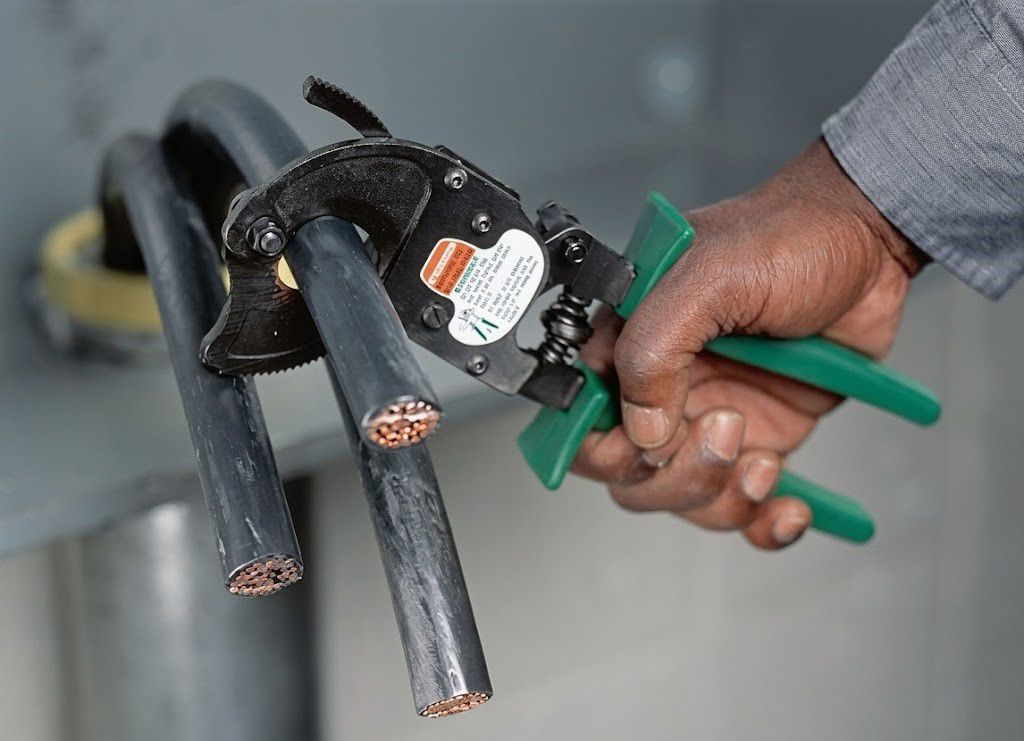
Hand-operated power pliers, the most popular choice
This model is the most accessible as it requires little training. The long lever allows for significantly stronger force transfer to the blades compared to regular pliers, resulting in a firmer and more compact grip, especially when working with copper and aluminum cables.
Asaki AK-8402 Cable Cutter: Suitable for light to medium maintenance and construction work. Handles copper and aluminum cables well, requiring minimal effort.
Asaki AK-8403 Cable Cutter: Higher cutting force, stable even when working with larger cables. Many construction teams choose this model because it reduces effort when dealing with difficult cuts.
TOPTUL Power-Assisted Cable Cutter: Well-made, durable blades, maintains a stable cutting feel even after prolonged use. Suitable for frequent users.
SATA Power-Assisted Cable Cutter: Easy to use, suitable for teams needing a stable tool with minimal adjustments.
This group handles most practical tasks well. If you're working with copper or aluminum cables and aren't sure of the limitations of each type, you should reread the article "What materials can cable cutters cut and why can't one method be used for all?" to avoid using them incorrectly from the start.
Read more:
What materials can cable cutters cut and why can't one method be used for all?
Tips for sharpening chipped cable cutter blades at home, important considerations for durability.
Ratchet pliers: a solution when your hand strength isn't strong enough
There's a point where power-assisted hand pliers start to "lose strength," especially when dealing with large cables or continuous cutting. The ratchet mechanism solves this by distributing the force in multiple increments, each press advancing a small distance instead of concentrating all the force at once.
TLP ratchet cable cutters: Robust design, even force distribution, suitable for cables larger than what lever pliers can comfortably handle.
Total cable cutter with gears: More accessible price point, suitable for those looking to upgrade cutting power without investing in hydraulics.
This type feels noticeably lighter, but requires decisive, rhythmic action. Repeatedly pressing and releasing the trigger causes uneven force distribution on the blade, leading to chipping over time. If you've experienced this, refer to the article "Tips for sharpening chipped cable cutter blades at home" for guidance on proper handling and prevention.
Hydraulic cable cutters: This type is for large cables and high-intensity work. When the cable cross-section increases significantly or the work frequency is high, mechanical pliers become unsuitable. At this point, hydraulics come into play. The clamping force is stable, the cut is clean and precise, and less strenuous effort is required.
TLP HHD-40: A familiar model, it handles large-diameter copper and aluminum cables well. Using it in construction projects will show a clear difference in effort and time.
Choosing pliers isn't about choosing the strongest, but about choosing the right one for the job. Power-assisted pliers handle most daily needs. Gear pliers help with more difficult tasks while maintaining flexibility. Hydraulic pliers are for heavy-duty situations where manual pliers are no longer suitable. When you put the right tool in the right job, you'll find the work becomes noticeably easier and the pliers' blades last longer.