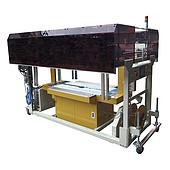
Many production managers assume that upgrading to an automatic strapping machine will immediately eliminate end-of-line bottlenecks. In real-world factory operations, however, strap feeding and heat-sealing account for only a small fraction of the total cycle time per package. The majority of downtime actually occurs while moving packages into the strapping zone, rotating cartons, or adjusting for varying package dimensions between production batches.
To permanently resolve throughput bottlenecks without overspending on capital equipment, industrial engineers must evaluate carton strapping machine based on actual Takt time, package dimensional consistency, and shipping area layout.
Analyzing Downtime Across Strapping Machine Configurations
On a semi-automatic strapping machine, the thermal sealing and cutting cycle takes only 1.5 to 2.5 seconds, yet the actual time required to complete a single strap typically stretches to 8 to 15 seconds. This happens because operators must manually pull the strap over the carton, insert the tip into the feed slot, and physically rotate the box 90 degrees for cross-strapping. Once output exceeds 150 to 200 cartons per hour, this repetitive manual handling causes noticeable operator fatigue and a drop in pace during the second half of a shift.
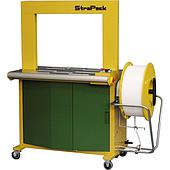
Automatic strapping machines eliminate manual strap threading by using an arch to automatically shoot the strap around the package, paired with integrated roller tables or guide conveyors. Cycle times remain fixed at 2 to 2.5 seconds per strap regardless of the hour of the shift. However, if a line handles multiple SKUs with widely varying dimensions or cartons taller than the standard arch clearance, an automatic machine becomes a bottleneck because packages cannot pass through the frame.
For oversized goods, bulky loads, or items already stacked on pallets, transporting the load to a stationary strapping machine takes longer than the strapping process itself. In these scenarios, battery-powered plastic strapping tools deliver decisive efficiency by bringing the tool directly to the load. Operators need only 3 to 4 seconds to complete tensioning, friction welding, and cutting with a single button press, completely eliminating double-handling across the warehouse floor.
Operational Performance and End-of-Line Investment Comparison
| Operational Metric | Semi-Automatic Strapping Machine | Automatic Strapping Machine | Battery-Powered Strapping Tool |
|---|---|---|---|
| Actual Hourly Throughput | 120 – 240 packages/hour (dependent on manual operator speed) | 600 – 1,200 packages/hour (consistent machine cycle ≤ 2.5 seconds/strap) | 150 – 300 packages/hour (dependent on travel distance between pallets) |
| Package Size Limitations | No maximum height limit, provided the package fits on the worktable | Strictly bounded by arch dimensions (e.g., W650mm x H500mm) | No restrictions on package size, irregular shapes, or pallet height |
| Labor Dependency | High; requires one dedicated operator per machine throughout the shift | Very low; capable of unmanned operation when synced with photo-eye sensors and conveyors | Moderate; one mobile operator can service multiple staging zones |
| Tension Range & Strap Material | Light to medium tension (50N – 450N), designed specifically for PP strapping | Consistent tension (100N – 700N), optimized for PP carton strapping | High tension (400N to 4,500N+), compatible with both PP and heavy-duty PET straps |
| Floor Layout Flexibility | Easily relocated via locking casters; requires only standard 220V single-phase power | Fixed along the end-of-line conveyor path; requires straight-line floor space | Fully cordless and portable; operates inside trucks, shipping containers, or cold storage |
Selection Strategy: Two Semi-Automatic Machines vs. One Automatic Machine
Within a comparable initial capital budget, facilities often weigh purchasing a single automatic strapping machine against deploying two semi-automatic units in parallel. The optimal choice depends primarily on the dimensional uniformity of outgoing packages.
If a packaging line handles diverse product formats within the same shift—such as small cartons mixed with bulky supply bundles—running two semi-automatic units like the CHALI JN740 across split stations yields higher overall throughput and greater operational agility. This setup also eliminates single-point-of-failure downtime when one unit requires maintenance or a strap coil change.
Conversely, for facilities manufacturing consumer goods, food, pharmaceuticals, or electronics with standardized carton sizes and volumes exceeding 3,000 cartons per shift, an automatic strapping machine such as the SCZN SCD-101A or Strapack SQ-800 delivers a faster return on investment. These systems integrate directly downstream from carton sealers to form a closed-loop packaging cell, completely eliminating dedicated machine operators.
Hybrid End-of-Line Architecture for Multi-Format Warehouses
Rather than forcing all goods through a single machine type, modern distribution centers and manufacturing plants increasingly adopt a two-tier packaging workflow. Standard-sized cartons travel along the main conveyor through an automatic arch strapping machine to clear high-volume throughput rapidly. Oversized loads, heavy palletized goods, or odd-lot shipments at the loading dock are handled independently using a handheld battery-powered plastic strapping tool such as the SIGNODE BXT3-16.
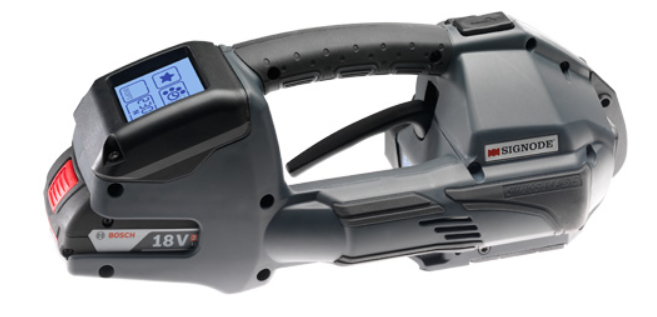
This segregated workflow ensures the primary conveyor line is never stalled by irregular loads, while leveraging the high tension and friction-weld joint strength of battery tools to secure heavy pallets prior to truck or container loading.
For on-site line assessments, Takt time calculations, and assistance selecting the ideal automatic, semi-automatic, or battery-powered strapping machine for your production requirements, explore detailed technical specifications or contact EMIN Vietnam's engineering team directly.