What is a particle counter?
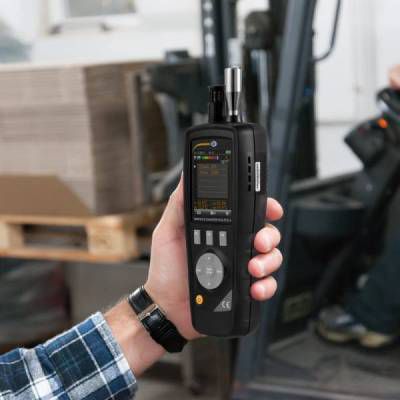
Each type of particle counter has a specific volumetric flow rate, which directly affects the airflow velocity passing through the device. Typically, this flow rate is measured in cubic feet per minute (CFM) or liters per minute (LPM). During calibration, each counter is set to a specific flow rate, and the accuracy of particle size measurement depends on this parameter.

To meet cleanroom classification standards (ISO 14644), a particle counter collects an air sample based on volume to provide statistical data.
Standards for selecting clean room particle counters
If compliance with ISO 14644-1:2015 cleanroom standards is required, the flow rate of the particle counter will determine the sampling duration. For example, a device with a flow rate of 1 CFM needs 35 minutes to sample 1 cubic meter of air. However, a counter with a flow rate of 50 LPM reduces this time to just 20 minutes.
In cleanroom monitoring, each ISO classification defines particle concentration limits. For an ISO Class 5 cleanroom measuring 0.1 µm particles, the particle counter must be capable of detecting concentrations of at least 100,000 particles/m³ (equivalent to 2,841 particles/ft³). If monitoring the same class with a particle counter measuring 0.3 µm particles, the requirement increases to over 102,000 particles/m³ (290 particles/ft³).
One crucial point to note: the ISO standard does not specify a 0.1 µm particle concentration requirement for ISO Class 6 or higher. Therefore, using a particle counter for particles smaller than 0.1 µm is unnecessary in these cases.
Reference:
Particle Counter CEM DT-9851M
Particle Counter CEM DT-9881M
See more: EMIN Hydrolysis Particle Counter
Cleanroom Monitoring: Which Method Is Right for You?
Regular clean room monitoring
Periodic cleanroom monitoring is a mandatory requirement. This process occurs at predetermined intervals, not exceeding 60 minutes during system operation. One of the most cost-effective solutions is utilizing a Manifold system, especially if installed during the cleanroom construction phase.
A portable particle counter can be easily connected to the Manifold system at any time. This system consists of 16 or 32 sampling ports, collecting data from multiple locations and channeling it into a single particle counter in a sequential process. However, due to its cyclic sampling mechanism, there is a risk of missing sudden airborne fluctuations that the system may not capture in real time.
Continuous clean room monitoring
Continuous (online) monitoring ensures uninterrupted data collection, allowing for timely detection of any incidents. Sampling intervals can be adjusted flexibly, but higher frequency provides better accuracy.
Short sampling intervals generate large volumes of data, which can overload the system. Therefore, standard sampling intervals typically range from 1 to 10 minutes. The decision between continuous or periodic monitoring depends on budget constraints and factory infrastructure.
For detailed tracking of particle movement, the ideal approach is to assign a dedicated particle counter to each monitoring point, though this can be costly. Alternatively, if continuous sampling is not required but sufficient data is needed to assess air quality trends, a Manifold system offers a cost-effective solution. However, this method is not suitable for particles larger than 5 µm due to data transmission limitations. nếu là anh, thìa huownshg
Connection interface of the particle particle counter
When choosing a particle counter, you should also consider the ability to connect to a central monitoring system. If the cleanroom has an Ethernet port (10 base-T or 100 base-T), prioritize a machine with network connectivity for easy integration. If the system uses serial communication, you should choose a machine that supports RS-232 or RS-485 communication standards to ensure stable data transmission.
Particle testing in laboratory environment
Laboratory particle count testing applications typically do not require compliance with ISO cleanroom standards. Instead, they focus on quantifying particles within a specific size range to determine pass or fail criteria based on the test requirements.
Selecting an appropriate particle counter depends on the type of material or sample being analyzed. Laboratories must define the critical particle size threshold (measured in µm) and the maximum allowable concentration.
High-flow-rate particle counters are often preferred due to their ability to reduce sampling time and enhance data accuracy. Since most laboratory tests target ultrafine contaminants below the micrometer scale, the range of suitable instruments is narrowed, simplifying the selection process.