
Board to Board & Mezzanine Connectors
Compact electronics often depend on reliable interconnects that can carry signals and power cleanly between stacked PCBs, daughter cards, and embedded modules. In these designs, Board to Board & Mezzanine Connectors help engineers save space, simplify assembly, and create a more modular architecture for control boards, communication modules, displays, and industrial electronics.
For buyers, design engineers, and sourcing teams, this category is typically less about choosing a generic connector and more about matching the right mating style, pitch, mounting format, and board spacing to the application. Whether the goal is a low-profile stacked layout or a robust PCB-to-cable transition within the same system, the right connector family supports both electrical performance and manufacturability.
Where these connectors fit in electronic design
Board-to-board interconnection is commonly used when two printed circuit boards need to mate directly without a separate wire harness. This is especially useful in compact equipment where vertical space, routing control, and assembly consistency matter. Mezzanine layouts are also widely used when a main control board needs to interface with expansion, I/O, memory, or communication boards.
Compared with loose wiring, direct PCB stacking can improve mechanical organization and reduce cable management inside the enclosure. It also helps create cleaner, more repeatable builds in production. In systems where a cable-based transition is still necessary, related options such as cable assemblies may be worth reviewing alongside board-level connector choices.
Common connector styles in this category
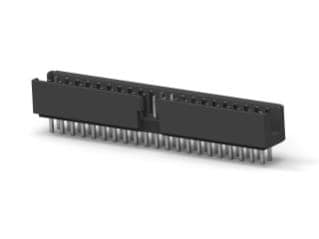
This category typically includes several interconnect approaches rather than one single format. Shrouded headers, socket strips, stacker headers, and ejector-style headers all serve different mechanical and assembly requirements. Some are selected for simple board stacking, while others are used to guide mating alignment, protect contacts, or support repeated installation and removal.
Examples in this range include 3M parts such as the 80001254129 shrouded header, 80001254095 shrouded header, DE500012088 board stacker header, and 80400030054 ejector header. These products illustrate how contact count, pitch, and mounting style can vary depending on whether the design prioritizes density, accessibility, or retention during servicing.
Choosing the right mating and mounting approach
One of the first selection steps is identifying how the boards will physically connect. A straight through-hole header may suit applications that need mechanical stability and conventional assembly, while an SMD stacker header can support more compact layouts. Designers also need to consider whether the connector must create a fixed board-to-board spacing, support guided insertion, or work in a shrouded arrangement for improved alignment.
Pitch and position count are equally important. Finer pitch options help reduce footprint, but they also require tighter PCB tolerances and more careful handling during design and assembly. Higher pin counts may be necessary for mixed signal, control, and power routing, but they should be evaluated together with insertion force, board support, and the accessibility of test and service points.
When PCB-to-cable connectors belong in the same shortlist
Not every compact design uses direct board stacking across the entire system. In many enclosures, one board may connect directly to another, while a separate board needs a cable exit to a front panel, peripheral module, or adjacent subassembly. That is why PCB-to-cable parts can still be relevant in a board-level interconnect workflow.
Products such as the Amphenol ESZH12160 and Amphenol ELFH2422G show this broader design context, where a board interface may need to transition to discrete wiring or a cable harness. The 3M 4664-6201 and the 3M CHG-1014-001010-KEP IDC connector are also useful examples when evaluating how ribbon or discrete cable termination may complement a mezzanine-style architecture rather than replace it.
Brands commonly considered for board-level interconnects
Within this category, buyers often compare established connector suppliers with broad board-level portfolios. 3M is frequently associated with headers, IDC interfaces, socket formats, and stacking solutions used in electronic assemblies across industrial and embedded applications. Amphenol is also a familiar choice when projects require dependable interconnect options across PCB and cable interface points.
Brand choice should still be tied back to the actual mechanical and electrical requirement of the assembly. Availability, mating compatibility, contact format, and the target production process often matter more than selecting a brand name alone. For projects that need a broader connector ecosystem, it can also help to review adjacent categories such as connector contacts where termination and replacement considerations are part of the design process.
Key factors that affect long-term reliability
Mechanical stability is just as important as electrical continuity. Connector performance in the field can be influenced by vibration, insertion cycles, enclosure constraints, and board flex. In stacked PCB designs, even a well-matched contact system can be compromised if the boards are not adequately supported or if the connector height does not align with the mechanical stack-up.
Temperature range, contact finish, and current path should also be reviewed in relation to the operating environment. For instance, an IDC-style cable connector and a fine-pitch board stacker may each perform well, but they are intended for different assembly conditions and service expectations. The best selection usually comes from evaluating the connector as part of the full electromechanical system, not as an isolated component.
Applications across industrial and embedded systems
Board to board and mezzanine connectors are widely used in control electronics, communication modules, interface boards, HMI subsystems, instrumentation, and compact embedded platforms. They support modular construction, which can make product upgrades, maintenance, and variant management easier across multiple device versions.
They are also relevant where signal organization and internal space efficiency matter more than user-facing connectivity. If the application instead requires external plug-in access or test-oriented interfaces, other connector types such as banana and tip connectors may be more suitable for that specific function.
Finding a practical fit for your design
A good selection process starts with the board layout, required stack height, pin count, mounting method, and expected assembly workflow. From there, it becomes easier to narrow the choice between shrouded headers, stacker headers, socket strips, ejector headers, or PCB-to-cable interfaces that complement the same system architecture.
This category brings together connector options used to build compact, structured, and serviceable electronic assemblies. If you are comparing parts for a new design or a replacement BOM, focusing on mating geometry, pitch, board spacing, and installation requirements will usually lead to a more reliable choice than comparing part numbers alone.
Get exclusive volume discounts, bulk pricing updates, and new product alerts delivered directly to your inbox.
By subscribing, you agree to our Terms of Service and Privacy Policy.
Direct access to our certified experts