Common Mistakes When Buying Industrial Dry Air Generators
Choosing the Wrong Capacity for the Industrial Dry Air Generator
One of the most frequent mistakes is selecting an industrial Dry Air Generator that does not match actual needs. Many businesses rely solely on the compressor capacity and overlook factors such as air consumption flow rate, the number of devices used simultaneously, or future expansion potential. For example, a small woodworking workshop uses an industrial Dry Air Generator with a capacity of 2m³/min for a system that requires 2.5m³/min in total. As a result, the output air is not dry enough, affecting product quality and increasing equipment maintenance costs.
Overlooking the Quality of the Output Air
Many buyers focus only on price without thoroughly checking parameters such as dew point, air purity, or the Dry Air Generator's ability to remove moisture. This often leads to output compressed air still containing moisture, which causes corrosion in pipes and production equipment.
Neglecting Warranty Services and Replacement Parts
Industrial Dry Air Generators operate continuously, so maintenance and replacement of parts are inevitable. However, many businesses pay attention only to the initial purchase price and ignore warranty, technical support, and the availability of replacement parts. Choosing an industrial Dry Air Generator from a lesser-known brand can result in no replacement parts being available when the machine breaks down, forcing production to stop for several days and causing significant losses.
Consequences of Making Mistakes When Buying Industrial Dry Air Generators
Increased operating and maintenance costs: When the industrial air dryer is not suitable, the system often has problems, leading to increased repair costs, replacement of components and having to invest in buying a new machine in the evening.
Reduced product performance: Poor quality compressed air will directly affect the equipment using air, reducing productivity and quality of output products.
Risk of production line failure: Moisture in compressed air is the main cause of corrosion and deposits in pipes, valves, cylinders... leading to production line failure and business interruption.
Experience in choosing to buy an effective industrial air dryer
Determine the correct usage needs: Calculate the required air flow based on the total actual usage needs, plus a reserve factor (usually 1.3 - 1.5 times the current demand). This helps the system operate stably and be ready to expand when necessary.
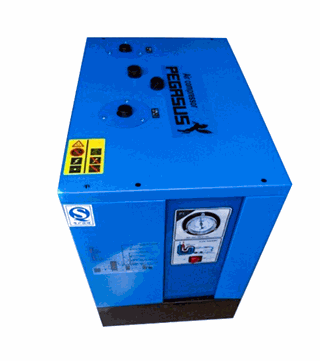
Prioritize products with clear technical specifications: You should choose an industrial air dryer with a dew point index, air cleanliness, and water vapor removal capacity that meets your industry standards. In particular, please refer to international standards on Dry Air Generator to ensure the quality of output compressed air.
Choose a reputable brand with good after-sales service: A large brand with a wide distribution and warranty system will help you feel more secure when using an industrial air dryer. In addition, carefully check the ability to provide replacement parts and after-sales technical support.