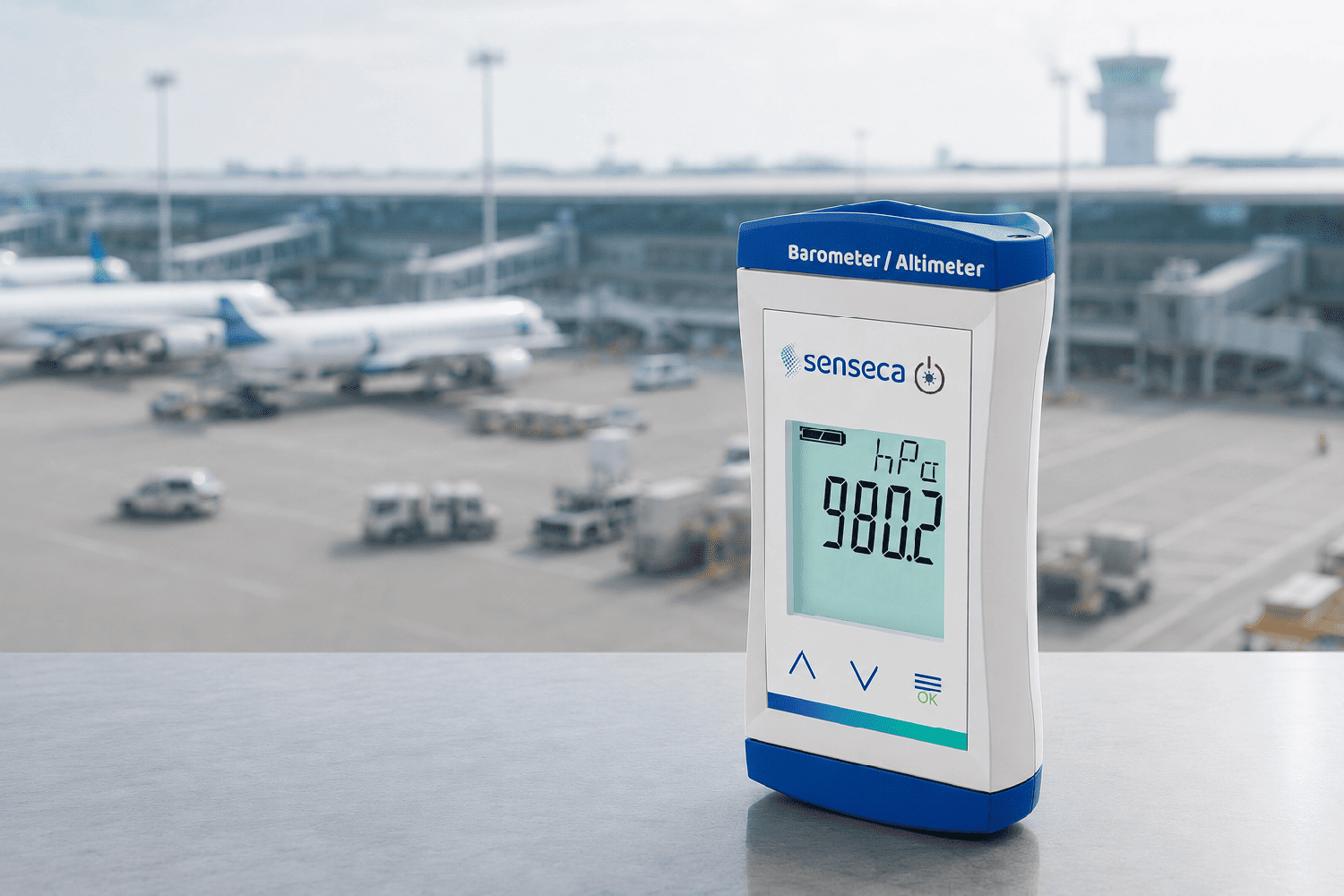
Air pressure meter (barometer) is widely used across numerous industries because atmospheric pressure serves as a reference parameter for calculations related to altitude, air density, airflow, gas volume, and instrument calibration.
Many systems do not measure atmospheric pressure directly, yet their performance still depends on it for error compensation. As atmospheric pressure changes, the algorithms, sensors, and mathematical models used by these systems must adjust accordingly. In the International Standard Atmosphere (ISA) model, a pressure difference of just 1 hPa corresponds to approximately 8.3 meters of altitude, which is sufficient to introduce measurable errors in applications requiring high precision.
Drones and UAVs: Atmospheric Pressure Determines Vertical Accuracy
GPS-derived altitude is inherently less stable than horizontal positioning. For this reason, modern flight controllers use sensor fusion algorithms that combine data from GNSS receivers, inertial measurement units (IMUs), and barometric pressure sensors.
An air pressure meter provides rapid feedback whenever a UAV changes altitude. This information allows the Kalman filter to maintain a stable flight state, particularly during altitude hold operations.
When atmospheric pressure changes rapidly due to weather systems or significant elevation differences between the launch site and the survey area, the controller must continuously update its pressure reference. If the pressure sensor exhibits drift or has not been properly calibrated, the UAV may experience altitude drift, even when the pilot makes no control input.
In LiDAR mapping and topographic surveys, vertical (Z-axis) errors often accumulate across multiple flights conducted under different atmospheric conditions. Recording atmospheric pressure continuously throughout the mission significantly reduces the amount of post-processing correction required.
Aviation: An Altimeter Is Essentially a Pressure Measuring Instrument
Aircraft altimeters determine altitude by measuring static atmospheric pressure, not the physical distance from the ground. The instrument converts pressure into altitude using the ICAO Standard Atmosphere model.
Whenever the airport issues updated QNH or QFE values, every altitude indication in the cockpit changes accordingly. A pressure error of only 3 hPa can result in an altitude error of nearly 25 meters, which is large enough to affect aircraft separation during approach and landing.
For this reason, aviation weather stations operate highly stable atmospheric pressure measurement systems with low uncertainty and regular calibration to ensure consistent pressure data for air traffic operations.
Cleanrooms: Correct Differential Pressure Does Not Always Mean Proper Operation
The differential pressure between cleanrooms is typically only 10–30 Pa, whereas atmospheric pressure is approximately 101,325 Pa. In practice, the operating pressure difference represents only a tiny fraction of the surrounding atmospheric pressure.
As atmospheric pressure decreases, the operating characteristics of supply fans, return fans, and airflow control systems also change. Although differential pressure sensors may continue displaying the design value, the actual air change rate (ACH) may deviate because the air density has changed.
Semiconductor, pharmaceutical, and microelectronics manufacturers therefore use atmospheric pressure instrument to monitor atmospheric pressure, differential pressure, and airflow simultaneously instead of relying on differential pressure alone when evaluating cleanroom performance.
HVAC Systems: Air Density Directly Influences Heat Transfer Performance
HVAC fans are typically selected based on volumetric airflow (m³/h). However, heat transfer performance depends on mass airflow, which is calculated as:
ṁ = ρ × Q
Where:
ṁ = mass flow rate
ρ = air density
Q = volumetric flow rate
Air density varies with both temperature and atmospheric pressure. As atmospheric pressure decreases, the same airflow of 5,000 m³/h carries less air mass, reducing heating or cooling capacity unless the system is compensated accordingly.
This is why professional HVAC design software always requires the installation altitude or local atmospheric pressure before calculating cooling loads and performing air balancing.
Environmental Monitoring Stations: Atmospheric Pressure Affects Gas Concentration Calculations
Gas analyzers measuring SO₂, NO₂, CO, O₃, and particulate matter (PM) do not directly determine concentrations under standard conditions. Air samples are collected at the actual ambient temperature and atmospheric pressure.
To convert measurement results into standardized units such as mg/Nm³ or ppm under standard conditions, the software simultaneously uses atmospheric pressure, temperature, and sampling flow rate.
If the atmospheric pressure input is inaccurate, the entire gas volume conversion becomes inaccurate as well. This error becomes more significant at higher elevations or in locations where atmospheric pressure fluctuates substantially between day and night.
For this reason, most automatic environmental monitoring stations integrate atmospheric pressure, temperature, and humidity sensors into a single meteorological module.
Laboratories: Atmospheric Pressure Is Part of Measurement Uncertainty
According to ISO/IEC 17025, environmental conditions must be monitored and recorded throughout testing whenever they can influence measurement results.
For gas flow calibration, analytical weighing, volumetric measurements, or determining air density, atmospheric pressure is an input variable in the measurement uncertainty model.
Many calibration laboratories use high-resolution air pressure meters to record atmospheric pressure continuously throughout the entire testing period. When measurement results need to be reviewed later, the recorded pressure history helps identify the causes of discrepancies between repeated measurements or between different laboratories.
Topographic Surveying and Mountaineering: Pressure Sensors Often Respond Faster Than Satellites
In mountainous terrain, dense forests, or narrow canyons, GNSS signals are often degraded by obstruction and multipath reflections. Because barometric pressure sensors do not rely on satellite signals, they can respond almost instantaneously to changes in elevation.
After calibration at a known benchmark, an atmospheric pressure meter can continuously monitor altitude changes with high resolution over relatively short distances. This is why many professional handheld GPS receivers designed for surveying and mountaineering continue to incorporate barometric pressure measurement to improve vertical positioning stability.
For applications in aviation, UAVs, HVAC systems, cleanrooms, environmental monitoring, and laboratories, selecting an air pressure meter should involve much more than comparing measurement range or stated accuracy.